
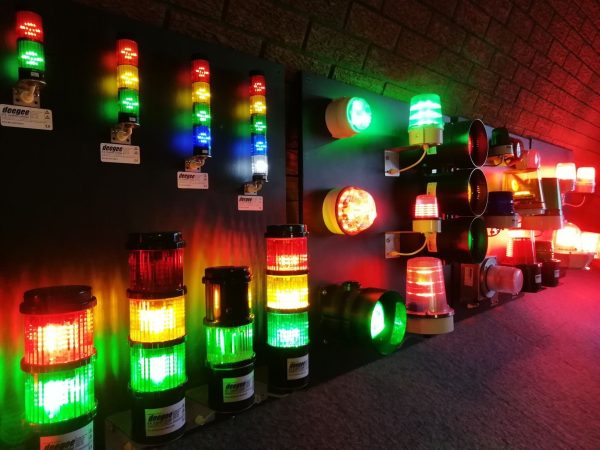
Day by day the xenon strobes are becoming more energy efficient. This is achieved by using LEDs rather than a gas filled xenon tube. This doesn’t mean the xenon gas filled tubes have vanished, they are available and on the market.
Storing energy in a capacitor, gas-filled xenon beacons then discharge through a low-pressure xenon gas, producing a brief burst of white light at a high intensity.
⚡ But what produces a flash in the Xenon Strobes? ⚡
The traditional 5 step flash:
🌟 Step 1: Charged from the power supply to a voltage, the energy storage capacitor is connected across the flash tube.
🌟 Step 2: Typically, the flash tube should remain non-conductive (including when the capacitor is fully charged) and does not flash.
🌟 Step 3: A separate small capacitor is charged from the same power supply. This generates a trigger pulse.
🌟 Step 4: The pulse generated by this trigger is enough to ionize the xenon gas inside the flash tube.
🌟 Step 5: The ionised xenon gas suddenly becomes low resistance and allows the energy stored on the capacitor to discharge through the flash tube, resulting in a brilliant white light with a short duration.
💡 And what limits their flash rate? 💡
Typically, a flash duration is from a few milliseconds down to a fraction of a millisecond. The trigger circuit includes timing components, in typical xenon strobe beacons, to generate a repetitive pulse.
For example: once every second, this is so the beacon produces a string of flashes 60 times a minute. For slower flash rates, strobes handle these easily.
However, flashing faster does have its limitations…
Generally, the maximum flash rate is 4 flashes per second. In addition, it takes a finite amount of time to charge up the flash capacitor to its maximum voltage. Making the maximum flash rate for most xenon strobe beacons to be 3 flashes per second.
Consisting of toughened glass with electrodes sealed in at each end. U or linear shapes are available, amongst various others.
Designed to handle a high-power density, the flash tubes must be made of high temperature resistant materials. You will commonly find that most include a capacitive trigger electrode (on the outside of the glass a wire is wrapped around the tube of a silver conductive coating).
For more information visit and to browse our products visit our website: beaconlamps.com
Contact our team now:
📧 mail@beaconlamps.com
☎️ 01283 550850