
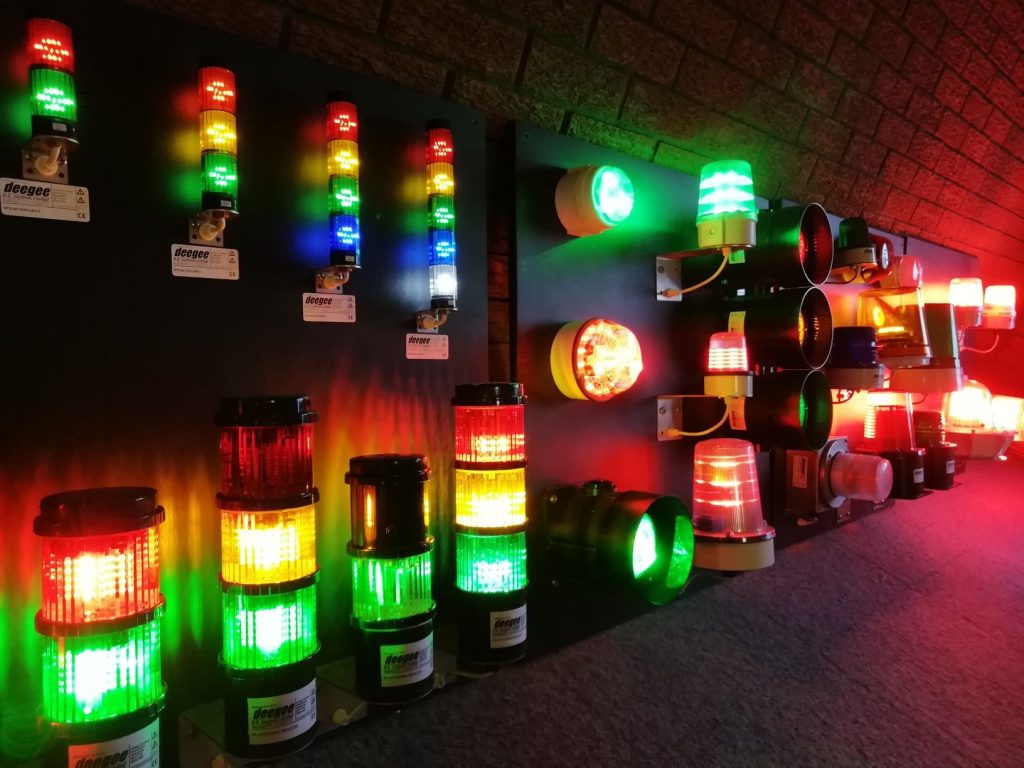
Visual signals are the key for immediate recognition and taking action to react accordingly.
Beacons are the perfect device to spotlight a strong and powerful message in the colours used, placement, and time of use. Placement of such signals contribute to delivering a clear message to be aware of your surroundings and to be cautious of any possibly dangers in the area.
Having the knowledge behind each of the colours could be the determining factor behind your next action. When installing ensure that you are choosing the right colour for your desired purpose.
For a rough guide, please see:
🔴 RED 🔴
A powerful, eye-catching signal that triggers an instinctive message to the viewer. Red indicates, danger, stop, hazard, emergency. Often, red beacons are used to serve a warning to keep people away from dangerous or hazardous areas. This translates to using on industrial/safety equipment. Red is a common signifier of danger/emergency/fault situation.
🟠 AMBER/YELLOW 🟡
Often recognised as a signal to slow down, or caution. Amber colour beacons can also be used on slow moving vehicles, construction site, airports, among other places. Commonly found where crowds form, to increase the awareness of caution. For safety/industrial equipment amber signals a similar warning to take caution, or alert, to an abnormal situation.
🟢 GREEN 🟢
Seen as a sign of assurance that things are under control. Associated with safety, it shines a message that a situation is being handled. When used on safety/industrial equipment green is the common sign for a safe/normal situation.
🔵 BLUE 🔵
Found on most emergency vehicles, like ambulances and police vehicles. Due to these blue beacons, they are unapplicable in certain places. Such as, public roads. If you have any uncertainty whether a blue beacon is the right fit for your project/application, please check with your local authority and they can advise. For blue signals used on safety/industrial equipment, it signals a mandatory significance situation.
⚪ CLEAR ⚪
Used alongside other colour beacons, they can be found in offices and schools as an alternative signal. It is often down to specific requirements for the end-users. Within safety/industrial equipment it is another clear sign that has no specific meaning assigned. This can be at the user’s own instruction and requested to add to their own signalling.
View our range of traffic management solutions: beaconlamps.com
📧 mail@beaconlamps.com ☎️ 01283 550850